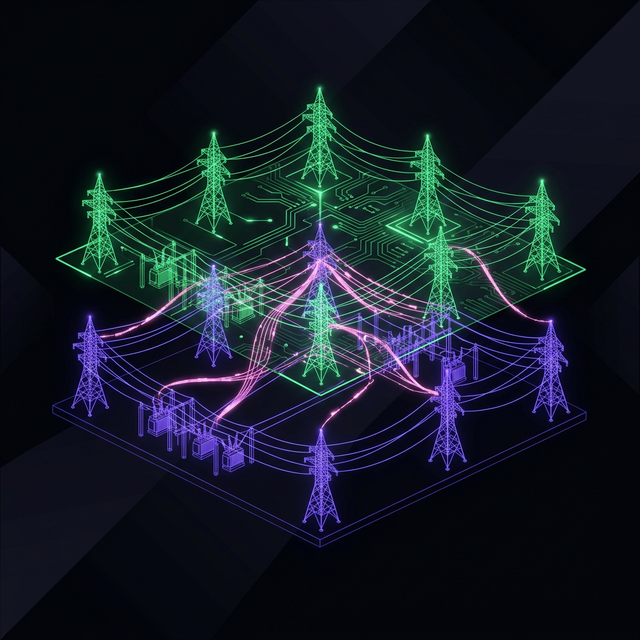
Power grids are among the most complex engineered systems on Earth. Millions of interconnected components, unpredictable demand patterns, and increasing penetration of intermittent renewables create a system that's inherently difficult to operate — and nearly impossible to plan for using static models.
Digital twins change the equation by creating live, data-driven replicas of grid infrastructure that can simulate, predict, and optimize in real time.
What is a grid digital twin?
A digital twin of a power grid is not just a 3D visualization. It's a real-time simulation layer built on top of live telemetry data — voltage, current, frequency, transformer temperatures, switch states — that mirrors the physical grid's behavior with high fidelity.
When something changes in the physical grid, the digital twin reflects it within seconds. When you want to test a scenario — "What happens if this transformer fails during peak load?" — you run it on the twin, not the real grid.
A digital twin doesn't replace engineering judgment. It gives engineers a sandbox where consequences are data, not outages.
Real-time telemetry integration
The foundation of any grid digital twin is its data pipeline. We integrate telemetry from multiple sources:
- SCADA systems providing real-time measurements from substations
- PMU (Phasor Measurement Units) for high-frequency grid state estimation
- Weather data feeds for correlating renewable generation with meteorological conditions
- IoT sensors on distribution-level assets for granular visibility
Scenario planning for the energy transition
As utilities integrate more solar, wind, and battery storage, the grid's behavior becomes harder to predict. Digital twins allow planners to simulate scenarios like:
- Mass EV adoption increasing evening demand by 40%
- A 500MW solar farm connecting to a constrained substation
- Cascading failure propagation during extreme weather events
These simulations inform investment decisions worth hundreds of millions — with data, not guesswork.
Building for resilience
Grid resilience isn't about preventing every failure. It's about ensuring that when failures occur, the system degrades gracefully and recovers quickly. Digital twins make this possible by giving operators visibility into failure modes they've never experienced — before they happen in the real world.