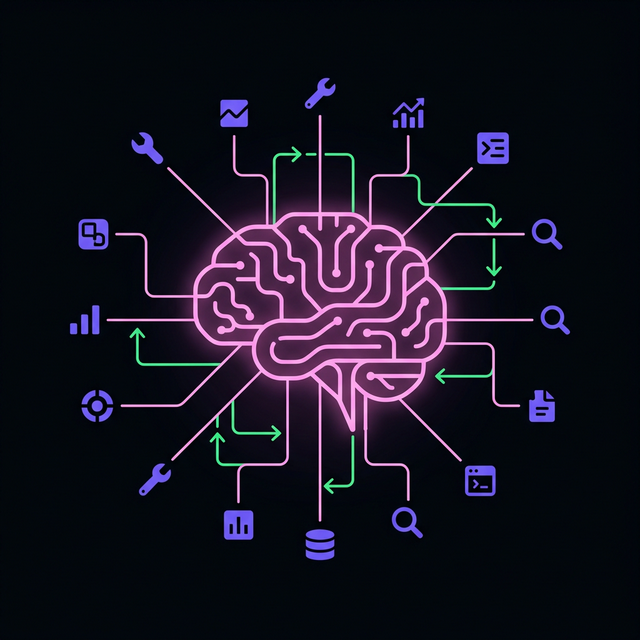
Large Language Models have moved far beyond chatbots. The real revolution isn't in generating text — it's in building autonomous AI agents that can reason, plan, use tools, and execute multi-step workflows with minimal human intervention. This is agentic AI, and it's reshaping how enterprises approach automation.
From prompts to agents
A prompt gets you a response. An agent gets you a result. The distinction is critical. While traditional LLM applications are reactive — ask a question, get an answer — agentic systems are proactive. They decompose complex goals into sub-tasks, select appropriate tools, handle errors, and iterate until the objective is met.
The best AI agent isn't the one with the biggest model. It's the one with the best tool integration, the clearest goal decomposition, and the most robust error recovery.
Architecture of an agentic system
At Enqube, we've built agentic AI systems for clients across fintech, energy, and manufacturing. The architecture pattern that consistently works involves four layers:
- Reasoning layer — An LLM (GPT-4, Claude, or open-source alternatives) that handles planning and decision-making
- Tool layer — APIs, databases, code execution environments, and external services the agent can invoke
- Memory layer — Short-term context for the current task and long-term memory for learning across sessions
- Orchestration layer — The control loop that manages agent state, retries, and human-in-the-loop escalation
Real-world applications
The most impactful agentic AI deployments we've seen aren't the flashiest. They're the ones that automate tedious, error-prone workflows that previously required skilled human attention:
- Automated code review and refactoring — Agents that analyze pull requests, identify bugs, suggest improvements, and even write tests
- Intelligent document processing — Agents that extract, validate, and route information from unstructured documents across regulatory workflows
- Autonomous DevOps — Agents that monitor infrastructure, diagnose incidents, and execute remediation runbooks
- Data pipeline orchestration — Agents that detect data quality issues, determine root causes, and apply corrections
The reliability challenge
The biggest obstacle to enterprise agentic AI isn't capability — it's reliability. LLMs hallucinate. API calls fail. Edge cases multiply exponentially in multi-step workflows. Building production-grade agents requires rigorous engineering practices:
Structured outputs — Force the LLM to respond in validated schemas, not free-form text. Guard rails — Define boundaries for what the agent can and cannot do. Observability — Log every decision, tool call, and outcome for debugging and audit. Graceful degradation — When the agent can't proceed, escalate to a human with full context.
Open-source vs. proprietary models
The choice between GPT-4, Claude, Llama, and Mistral isn't just about capability — it's about control, cost, and compliance. For clients in regulated industries, we often deploy fine-tuned open-source models on private infrastructure, ensuring data never leaves the client's environment while maintaining competitive performance.
What's next
The trajectory is clear: AI agents will become the primary interface between humans and complex systems. The organizations that invest in building reliable, tool-integrated, domain-specific agents today will have a compounding advantage as the underlying models continue to improve. The question isn't whether to adopt agentic AI — it's how to build it right.